
How to Analyze a CrossFit Workout: 7 Signals Beyond Your Score
A CrossFit score tells you what happened. It rarely tells you why.
Two athletes can finish with the same time while experiencing completely different workouts. One may hold even splits and finish hard. The other may sprint, rest, and survive. One may be limited by breathing; the other by grip, strength, skill, or a poor scaling decision.
A useful post-workout analysis adds six signals to the score: pace, time in heart-rate zones, heart-rate drift, recovery between efforts, the movement that limited performance, and the context surrounding the session. Together, those signals turn a result into one decision for the next attempt.
You do not need an hour or a sports-science lab. For normal training, a structured ten-minute review is enough.
Begin With the Plan You Intended to Execute
Analysis starts before the timer.
Write one sentence describing the intended stimulus and strategy. For example:
Twenty-minute AMRAP. Hold one round every 65–70 seconds for 15 minutes, then increase pace if transitions and breathing remain controlled.
That sentence creates a standard for the review. Without it, you can only describe the outcome after the fact.
Include the planned scaling, loads and rep breaks. If you intended 8+7 thrusters but opened unbroken, that change may explain the later slowdown better than any wearable metric.
The Seven Signals Worth Recording
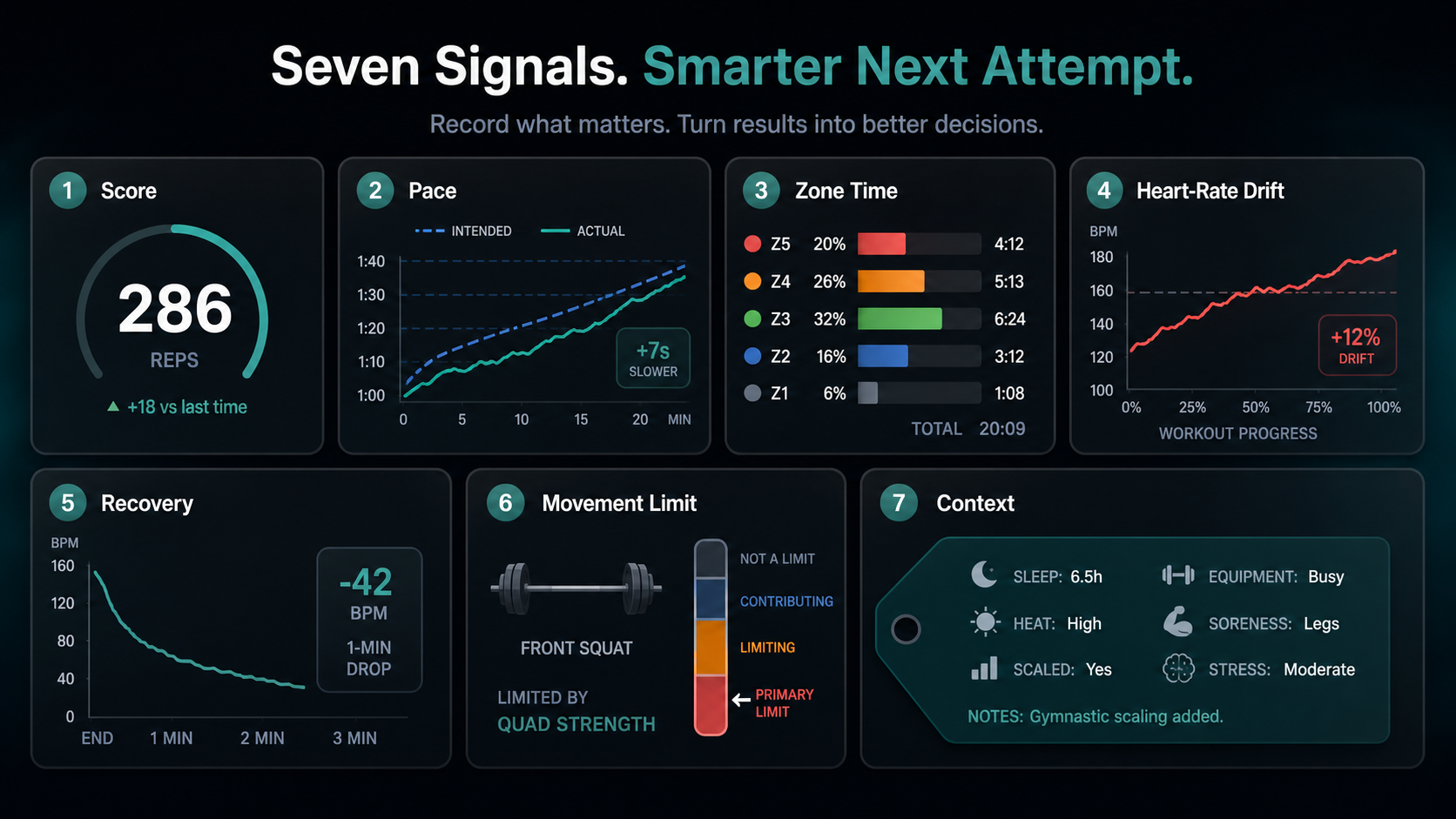
A useful review combines performance, cardiovascular response, movement limitations and context.
1. Final score
Record the official result exactly:
- Time, including the time cap when applicable
- Rounds and repetitions
- Load or calories
- Prescribed or scaled
- Tie-break time
- Relevant equipment or movement variation
Precision matters when you repeat a workout. “About 12 rounds” will not help six months later.
The score remains the primary performance outcome. The other signals explain it; they do not replace it.
2. Intended versus actual pace
For rounds-based workouts, record two or three checkpoints rather than every split. Compare the opening, middle and finish.
Ask:
- Did the first rounds match the plan?
- When did the pace begin to change?
- Did transitions or actual movement speed create the slowdown?
- Did you finish faster because you paced well or because you held back too much?
The Cindy guide recommends finding a repeatable round time before attempting the full 20 minutes. If you planned 70-second rounds and opened with three rounds near 50 seconds, the later collapse is not mysterious. The pace data has already explained it.
For machine work, record split, watts, cadence or calories per minute. For barbell and gymnastics work, rep schemes and rest duration are often more useful.
3. Time in heart-rate zones
Heart-rate zones describe internal cardiovascular load. Start with total time and percentage in each zone, then inspect when that time occurred.
The correct distribution depends on the workout. A recovery piece should remain easy. A long threshold-style workout may include sustained upper-zone work. A short sprint can feel maximal without accumulating much recorded time in the highest zone because heart rate rises with a delay.
Use the detailed guide to analyzing heart-rate zones after a workout when the chart and the workout’s purpose do not agree.
Never treat Zone 5 minutes as points. More high-zone time is not inherently a better workout.
4. Heart-rate drift
Drift means heart rate rises while external output stays similar. During a long steady workout, some late rise can be normal. Larger or earlier drift may reflect an aggressive pace, heat, dehydration, insufficient fueling, fatigue, or zone boundaries that do not fit you.
In CrossFit, output is rarely perfectly steady, so interpret drift carefully. Compare similar rounds or repeated machine segments rather than the entire mixed workout.
Example: every round contains a 500-meter row at the same split. If heart rate is progressively higher after each row and falls less during the following movement, the session is becoming more internally costly even before the row pace changes.
Heart-rate monitoring research emphasizes that temperature, hydration and day-to-day factors affect the relationship between heart rate and workload (Sports Medicine). Add those conditions to the log rather than blaming every rise on fitness.
5. Recovery between efforts
Interval workouts create a simple question: did you recover enough to repeat the intended quality?
Look at:
- How far heart rate fell between intervals
- Whether breathing settled
- Whether the next repetition matched the previous output
- Whether recovery time shrank because the work took longer
- How quickly you felt composed after finishing
Compare recovery with your own similar workouts. A clinical study famously connected delayed post-exercise heart-rate recovery with prognosis in a referred patient population (New England Journal of Medicine), but that finding does not turn a one-minute watch value after a WOD into a diagnosis.
Use recovery as a personal trend. Seek medical care for chest pain, fainting, palpitations or unusual breathlessness rather than trying to interpret symptoms through a training log.
6. The movement that limited performance
Name the primary limiter:
- Cardiovascular capacity
- Local muscular endurance
- Maximal strength
- Grip
- Skill or technique
- Mobility
- Pain
- Strategy or transitions
Be specific. “Burpees were hard” is not enough. Did breathing force pauses? Did triceps fatigue slow the push-up? Did you lose time stepping around the bar? Did the prescribed box height change your mechanics?
Heart rate cannot answer these questions. A low-zone strength session can still be extremely demanding, and a high heart rate does not prove that cardio caused the slowdown.
This is where video, notes and honest perceived effort matter. If 17.5 falls apart because large thruster sets create long rests, the best next decision may be smaller planned sets—not more aerobic training.
7. Context
Your body does not arrive at the gym as a controlled experiment.
Record unusual factors:
- Sleep duration and quality
- Heat and humidity
- Hydration and fueling
- Work or life stress
- Soreness and pain
- Previous day’s training
- Equipment setup
- Crowded transitions
- Scaling changes
- Sensor errors
One sentence is usually enough. Context prevents false conclusions. A slower score after four hours of sleep does not automatically mean fitness declined.
A Worked Example: Two Cindy Attempts
Imagine an athlete repeats Cindy after eight weeks.
| Signal | Attempt 1 | Attempt 2 |
|---|---|---|
| Score | 18 rounds + 7 reps | 20 rounds + 2 reps |
| Opening pace | 48–52 sec per round | 58–62 sec per round |
| Middle pace | Falls to 72–80 sec | Holds 61–66 sec |
| Heart-rate pattern | Early spike, sustained high | Gradual rise, late push |
| Limiter | Pull-up grip and long rests | Breathing near finish |
| Context | Poor sleep | Normal sleep |
The second score is better, but the deeper improvement is pacing. The athlete deliberately started slower, preserved grip, held transitions, and saved the highest cardiovascular effort for the end.
The next decision should not be “go faster everywhere.” A better decision is to keep the opening plan and test whether slightly shorter transitions in minutes 10–16 produce another round without sacrificing pull-up quality.
That is the purpose of analysis: one defensible adjustment.
A Ten-Minute Post-Workout Workflow
Complete this after benchmarks, competition workouts and important training sessions:
Minutes 0–2: Capture facts
Record the score, scaling, load, rep scheme and important splits before you forget them.
Minutes 2–4: Describe the experience
Write the primary limiter, perceived effort from 0 to 10, and one sentence about what surprised you.
Minutes 4–7: Review the timeline
Look at round pace, machine output and the heart-rate graph. Identify the first meaningful change—not necessarily the highest number.
Minutes 7–9: Add context
Note sleep, heat, soreness, stress, fueling and sensor quality when relevant.
Minute 10: Choose one action
Examples:
- Open five seconds slower per round.
- Break pull-ups before grip failure.
- Move the chalk closer.
- Reduce the load to preserve the intended stimulus.
- Use a chest strap for the next comparison.
- Repeat the same strategy under normal conditions.
If you finish with seven changes, you have not prioritized.
Review the Week, Not Only the Highlight
Individual workouts are noisy. A weekly view helps you identify whether the training mix matches your plan.
Training-load research distinguishes external load—the work completed—from internal load—how the athlete responded. A consensus statement on athlete monitoring recommends interpreting load through a multidisciplinary, contextual approach rather than relying on one number (International Journal of Sports Physiology and Performance).
For a recreational CrossFit athlete, a weekly review can remain simple:
- Number of classes and total training time
- Number of genuinely hard sessions
- Time spent in low and high heart-rate zones
- Strength volume or key lifts
- Average session effort
- Pain, soreness, sleep and motivation trends
One practical cross-sport measure is session RPE: multiply the session duration in minutes by a 0–10 rating of the entire workout. A review of the method describes it as a simple tool used across aerobic, interval, resistance and team-sport training (Frontiers in Neuroscience). It is not perfect, but it gives a 60-minute easy class and a 60-minute maximal effort different internal loads.
When a week feels unexpectedly hard, compare it with the baseline built over the previous several weeks. The guide to acute versus chronic training load explains why the same workload can be routine after consistent preparation and a major spike after illness, travel or missed training.
Do not use a ratio as an injury-prediction machine. Use the comparison to notice sudden changes and ask better questions.
Track Recovery as a Trend
Recovery is broader than readiness scores.
Heart rate, resting heart rate and HRV may contribute useful information, but a review by Buchheit emphasizes measurement error, training context and combining heart-rate measures with logs and subjective information (Frontiers in Physiology).
Track a small, repeatable set:
- Sleep
- Fatigue
- Soreness
- Mood or stress
- Motivation
- Pain
- Whether easy work felt easy
- Whether key sessions matched the plan
The ZTL guide to tracking recovery as a trend provides a simple daily and weekly structure. The important principle applies directly to CrossFit: one bad day is information, while several connected changes form a pattern.
Mistakes That Make a Training Log Less Useful
Recording only PRs
Normal sessions reveal consistency, tolerance and warning signs. A log made only of highlights cannot show the path between them.
Writing vague notes
“Felt bad” becomes useful when changed to “four hours of sleep; grip failed in round six; breathing normal.”
Letting wearable data overrule obvious reality
If a watch reports 85 bpm while you are gasping through burpees, check the sensor. Numbers support judgment; they do not replace it.
Comparing unrelated sessions
Different loads, scaling, equipment, heat and movement standards can make two workouts unsuitable for direct comparison.
Turning every result into a program change
Repeat observations before rebuilding your training. Consistency makes trends visible.
The Practical Takeaway
Record the score, then explain it.
Compare your intended and actual pace. Read heart-rate zones in the context of the workout. Look for drift and recovery patterns. Name the movement that limited you. Preserve the conditions that made the day unusual. Finally, choose one adjustment.
Zone Training Log keeps workout history, zone summaries, titles, notes, tags and longer trends together so that the explanation remains attached to the result. The value is not having more data. It is remembering enough context to make the next attempt smarter.
TAGSCrossFit training log, workout analysis, WOD pacing, heart rate recovery, training load