
Zone 2 for CrossFit Athletes: Build Your Engine Without Wrecking Your WODs
Zone 2 can help a CrossFit athlete accumulate aerobic work without turning every conditioning session into another test. The goal is not to replace strength, skills, intervals, or WODs. It is to build repeatable low-intensity volume that supports recovery between efforts and gives hard sessions room to stay hard.
For many recreational athletes, CrossFit already supplies abundant intensity. The mistake is adding Zone 2 as extra punishment. A useful session should finish with energy in reserve and should not reduce the quality of tomorrow’s lifting or conditioning.
Start with one or two sessions of 30 to 45 minutes per week. Use a bike, rower, incline walk or easy run, keep the effort conversational, and increase duration only when the rest of your training remains stable.
What Zone 2 Means
In a common five-zone heart-rate system, Zone 2 usually represents controlled aerobic work: breathing is elevated but stable, conversation remains possible, and the effort feels approximately 3 to 4 out of 10. It sits above very easy recovery work and below the moderate intensity where speaking becomes noticeably harder.
That is a practical definition, not a universal physiological boundary. Coaches and researchers use different zone models. A three-zone model often labels the intensity between the first and second physiological thresholds as Zone 2, while a five-zone watch typically calls a lower aerobic range Zone 2. Those are not the same thing.
Before comparing advice, identify the system being discussed. The complete Zone 2 training guide explains the difference between models, testing methods, breathing cues, heart-rate reserve and age-based estimates.
For this article, Zone 2 means sustainable low-intensity aerobic work below the first major threshold—the kind you can repeat frequently without a large recovery cost.
Why CrossFit Athletes May Benefit
CrossFit performance is not purely aerobic. Strength, power, local muscular endurance, skill, transitions and anaerobic capacity all matter. But longer AMRAPs, repeated intervals, high-repetition cyclical work and recovery between rounds depend heavily on the aerobic system.
Low-intensity training gives you a way to develop aerobic volume without repeating the mechanical and psychological cost of all-out WODs. Reviews of endurance training consistently find that well-trained athletes perform a large share of their volume at low intensity, although the best distribution depends on sport, phase and athlete. A recent systematic review and meta-analysis found a small advantage of polarized training for VO2peak in some settings, but not universal superiority across every performance outcome (Sports Medicine).
That evidence should not be copied mechanically into CrossFit. Elite runners and cyclists have different needs and much larger weekly volumes. The transferable principle is simpler: easy aerobic work can add volume while preserving a clear contrast between easy and hard days.
Zone 2 may help you:
- Accumulate more aerobic minutes with manageable fatigue.
- Practice steady breathing and output.
- Improve confidence at sustainable machine paces.
- Add conditioning without another high-impact running session.
- Create a genuinely easy day between demanding classes.
It will not directly fix weak gymnastics, poor barbell technique or insufficient maximal strength.
Zone 2 Is Useful, Not Magical
The popularity of Zone 2 has produced claims that it is uniquely optimal for mitochondria, fat oxidation, longevity, and nearly every endurance adaptation. The evidence is more restrained.
A 2025 narrative review concluded that current research does not establish Zone 2 as uniquely optimal for improving mitochondrial capacity, fat oxidation or cardiorespiratory fitness in the general population; higher intensities can provide equal or greater adaptations for some outcomes (Sports Medicine). The authors’ practical message is not to abandon low-intensity exercise, but to avoid treating one intensity as the entire program.
That fits CrossFit well. Your classes already provide vigorous work. Zone 2 fills a different role: sustainable aerobic volume with a lower recovery cost.
Where Zone 2 Fits Around CrossFit
Protect the sessions that matter most. If Tuesday contains heavy squats and a demanding bike workout, placing a long run on Monday may be a poor choice. Use the easiest modality and placement that lets you arrive ready.
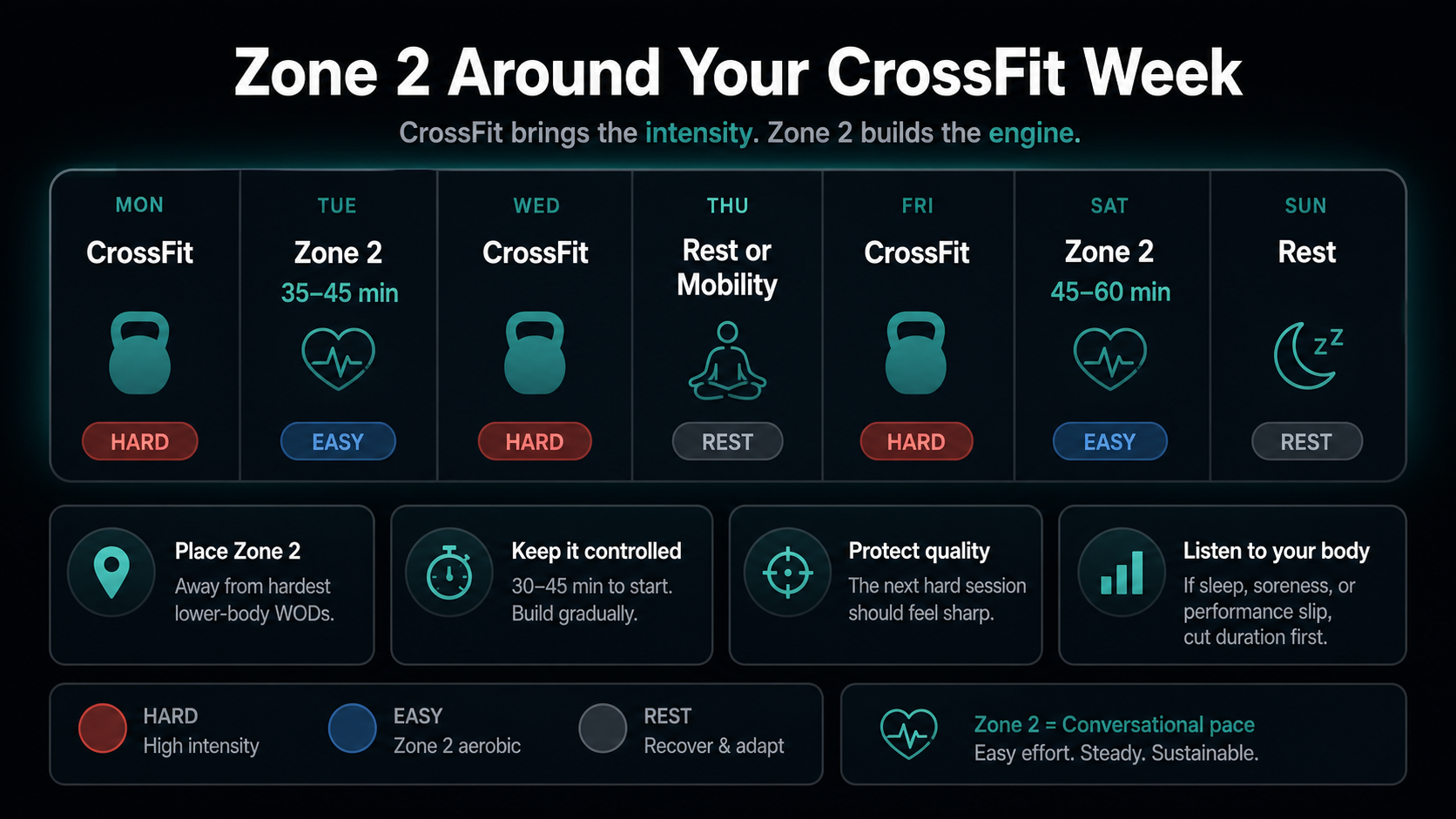
An example, not a rule: keep easy days easy and preserve quality on the hard days.
If you attend two classes per week
Add two Zone 2 sessions of 30 to 60 minutes on non-consecutive days. You have enough space to keep them separate from classes and gradually extend one session.
If you attend three classes per week
Begin with one 35- to 45-minute session. Add a second only when sleep, soreness, motivation and class performance remain normal. The example week above is a sensible eventual structure, not necessarily the correct first week.
If you attend five classes per week
Do not automatically add more training. First identify which classes are truly hard. One short Zone 2 session may replace optional moderate conditioning or become part of an active recovery day. If all five classes are demanding, recovery is the priority.
The existing WOD Time Calculator guide to aerobic capacity intervals provides hard conditioning examples. Zone 2 belongs on the opposite side of the intensity spectrum; confusing the two turns every day into medium-hard work.
Choose the Modality That Creates the Least Conflict
Bike
An air bike or stationary bike makes intensity easy to adjust and avoids running impact. It is often the best starting point after a leg-heavy week, provided you resist chasing calories or watts.
Rower
Rowing is useful and specific to many CrossFit workouts, but it involves substantial muscle mass and can drift above Zone 2 quickly. Lower the stroke rate, relax the recovery and let breathing govern the pace.
Incline walk
Walking is underrated. An incline treadmill can raise heart rate without the impact or skill demands of running. It is especially useful for athletes whose easy jog already exceeds the desired intensity.
Easy run
Running builds running economy and is convenient, but it adds impact. Use run-walk intervals when necessary. Walking a hill to preserve the intended effort is accurate training, not failure.
Mixed machines
You may split a 45-minute session between bike, rower and walking to reduce local discomfort. Keep transitions calm. The purpose is continuous controlled work, not a three-station metcon.
Find the Right Intensity
Heart rate provides a useful guardrail, but formulas are starting points.
Use three signals together:
- Conversation: You can speak in complete sentences without gasping.
- Perceived effort: Approximately 3 to 4 out of 10.
- Heart rate: Stable inside a range that matches your chosen zone method.
If you know your tested maximum and resting heart rate, the Zone 2 Heart Rate Calculator can estimate a starting range using heart-rate reserve. If you only have an age-based estimate, treat the result more cautiously.
Conditions matter. Heat, dehydration, caffeine, fatigue, hills and poor sleep can raise heart rate at the same output. If an easy session repeatedly becomes moderate work, review why easy sessions drift into Zone 3 before assuming that you need to push harder.
How to Progress Without Accumulating Junk Fatigue
Progress duration before intensity. Zone 2 does not become more effective because you ride harder.
A conservative eight-week progression could look like this:
| Weeks | Frequency | Duration |
|---|---|---|
| 1–2 | 1–2 sessions | 30 minutes |
| 3–4 | 2 sessions | 35–40 minutes |
| 5–6 | 2 sessions | 40–50 minutes |
| 7–8 | 2 sessions | 45–60 minutes |
Hold or reduce the plan when:
- Your normal WOD pace declines.
- Heavy warm-up weights feel unusually slow.
- Easy aerobic work no longer feels easy.
- Sleep, soreness or motivation worsens.
- Resting heart rate is repeatedly unusual for you.
- You develop impact-related pain.
The progression is successful when it becomes boringly repeatable.
Should You Do Zone 2 After Strength Training?
Combining endurance and strength training does not automatically destroy strength or muscle gains. An updated systematic review and meta-analysis found concurrent aerobic and strength training broadly compatible for maximal strength and hypertrophy, although explosive strength may be more sensitive when both forms are performed in the same session (Sports Medicine).
Practical priorities still matter:
- If strength is the priority, lift first.
- Keep the Zone 2 portion short enough that technique and recovery remain good.
- Use a low-impact modality after heavy lower-body work.
- Separate longer aerobic sessions from important strength sessions when your schedule allows.
- Do not turn the final ten minutes into intervals.
Individual response matters more than a universal rule. If a 30-minute easy bike after lifting has no effect on the next day, it may fit well. If it consistently leaves your legs flat, separate or shorten it.
Common CrossFit Zone 2 Mistakes
Chasing machine numbers
Calories per hour, watts and split times make controlled training competitive. Cover the display if necessary and use heart rate plus breathing.
Starting too fast
Heart rate takes time to rise. Begin below the target and let the first 10 minutes act as a warm-up.
Adding instead of replacing
If you already train six days per week, another two hours may not be the answer. Replace accidental medium-intensity conditioning before adding volume.
Treating every excursion as failure
A short rise on a hill or during a transition does not erase the session. Look at the overall distribution and how quickly you returned to the intended effort.
Copying endurance athletes’ volume
High-volume cyclists can tolerate hours of low-impact work. That does not make the same dose appropriate beside squats, Olympic lifts, gymnastics and high-repetition WODs.
Using Zone 2 as medical treatment
Exercise can support health, but heart-rate zones are not diagnostic or individualized medical prescriptions. The World Health Organization recommends regular aerobic and muscle-strengthening activity for adults, but athletes with symptoms, cardiovascular disease, major illness, or medication that affects heart rate should seek qualified guidance.
How to Know It Is Working
Do not judge progress by one fast session. Review comparable efforts every few weeks:
- Is your pace or wattage higher at a similar heart rate?
- Is heart rate lower at the same output?
- Is there less late-session drift?
- Can you complete more weekly training without feeling crushed?
- Are hard WODs still high quality?
- Do you recover more predictably between repeated efforts?
These are trends, not promises. Compare the same modality under similar conditions and keep notes about heat, sleep and prior training.
The Practical Takeaway
CrossFit supplies intensity. Zone 2 supplies controlled volume.
Start with one or two short sessions, choose a modality that creates little interference, and keep the effort conversational. Progress time slowly. Protect strength, skill and hard conditioning. If easy work begins to reduce the quality of the rest of your week, it is no longer serving its purpose.
Use Zone Training Log to review time in zones across workouts and weeks, preserve notes about how each session felt, and see whether the low-intensity work is supporting—not crowding—the training you care about.
TAGSZone 2 CrossFit, aerobic capacity, CrossFit engine, heart rate zones, conditioning